Wolf-dog
Train DreamsThe wolf-dog hybrid is the novel’s name for an animal whose uncertain parentage makes the boundary between dog and wolf impossible to keep secure. First associated with Robert Grainier’s red dog and her wolfish-looking litter, it later becomes part of a wider folklore of animals that rescue, understand, or attack human beings. The term therefore describes more than a biological mixture: it marks the point where domestic companionship, wilderness, fear, and local storytelling begin to overlap.
Origin in Grainier’s Settlement
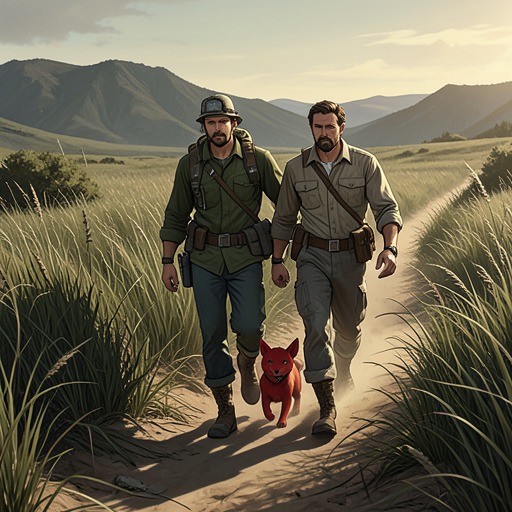
In early June, after the Moyea Valley fire had destroyed Grainier’s former home, his little red-haired female dog took up residence in his new cabin and whelped four pups. The puppies appeared distinctly wolfish, an unsettling development in a clearing where nature was already recomposing itself from ash. Grainier had been living among returning animals, eating mushrooms and trout, keeping a nanny goat and hens, and hearing wolves answer one another across the peaks. The litter consequently entered a world in which the distinction between household animal and wild creature was already being tested by the recovering landscape.
Grainier discussed the pups with Kootenai Bob, a longtime acquaintance who refused liquor and worked around Meadow Creek. Bob explained a Kootenai rule about wolf reproduction: only one pair in a den produced pups, the chief male of the wolf tribe mating with the single female in heat. On that account, Bob rejected the idea that the wandering dog had simply produced a litter of wolves. Grainier proposed that she might have encountered the wolf pack at the precise moment she came into heat, allowing the wolf king to mate with her because of the novelty of the experience. Bob left the possibility open and gave the hybrid its memorable name, suggesting that Grainier might have started his own pack.
The Pup That Could Not Howl
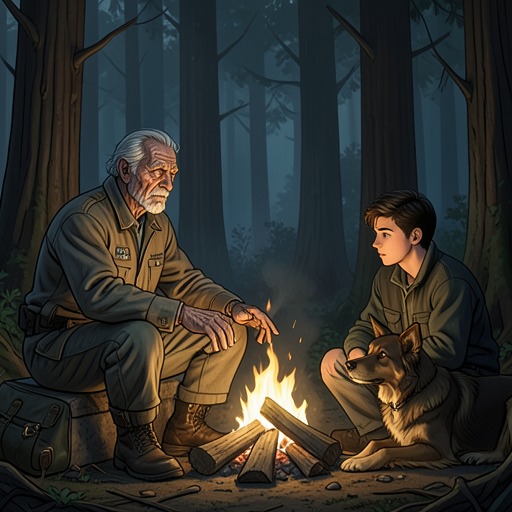
Three pups wandered away as soon as the mother weaned them. One poorly coordinated male remained near the cabin, tolerated by its mother and regarded by Grainier as certainly wolf-begotten. Yet the animal did not answer the distant packs when they sang at dusk. Grainier interpreted this silence as a failure to grow into its own nature. He knelt beside the pup and howled to teach it, then stood and howled sorrowfully over the gorge when the lesson produced no response.
The failed instruction reveals Grainier’s own investment in the hybrid. He wants the animal to confirm its ancestry, but his repeated howling also serves him rather than the pup. When the wolves called in the evening, Grainier answered them because doing so released something heavy from his heart and left him warm and buoyant. The supposed wolf-dog thus becomes a companion to his grief and isolation even without behaving like a wolf. Its silence is as significant as its appearance: the body suggests wildness, while its conduct refuses the expected identity.
Kootenai Bob treated that conduct as evidence of another kind. When Grainier reported that he himself had begun howling, Bob answered with the proverb, “There’s not a wolf alive that can’t tame a man.” The saying reverses the ordinary hierarchy in which humans domesticate animals. It implies that contact with wolf nature can alter the human being who approaches it, making Grainier’s evening chorus part of the hybrid’s significance even though the pup never howls. Before autumn, the pup disappeared. Grainier hoped it had crossed into Canada to join its brothers, but he had to accept that it might instead have become food for a hawk or coyotes.
From Animal to Local Legend
The wolf-dog hybrid belongs to a larger network of stories circulating along the Idaho Panhandle and the Kootenai River. Grainier heard astonishing accounts of dogs performing rescues, tricks, and feats of intelligence that seemed almost human. One prospector at Sylvanite survived an explosion because his dog made such a nuisance of itself at the saloon that someone finally followed it home and discovered its injured master. These stories place the hybrid on a continuum rather than isolating it as a single marvel: ordinary dogs already appear capable of crossing the line into humanlike understanding, while wolf-dogs intensify the fear that animals possess knowledge beyond human control.
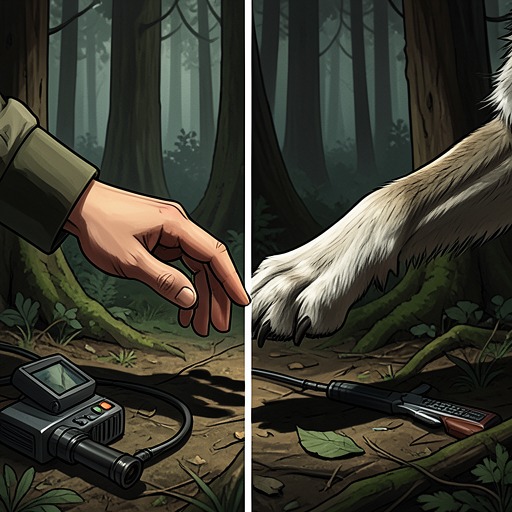
The most disturbing version concerns Peterson, a surveyor for the Spokane International Railway. Grainier hauled Peterson, wrapped in a blanket and half sitting upright on sacks of wood chips, from the Moyea River Road toward Bonners Ferry after Peterson had been shot by his own dog. Peterson said that the dog had slipped its rope and evaded him, stepping backward whenever he advanced. When Peterson swung his rifle by the barrel and struck at it with the butt, the dog somehow fired the weapon, hitting him in the left shoulder and chest.
Peterson attributed the attack to the dog’s association with the wolf-girl. He said that he had once allowed the animal inside because it would not stop yapping, intending to keep it close enough to beat with a kindling stick. The next morning the dog escaped through a window, worked back and forth across the porch and yard, went into the woods, and remained away for thirteen days. When it returned, it was almost wild and scarcely knew Peterson. In Peterson’s account, the absence became an initiation into wolf society, and the changed dog became an intermediary between the human household and the wolf-girl’s world.
Kootenai Bob allegedly examined the returned dog’s eyes and warned Peterson that he could see the wolf-girl’s image in their darkness. He urged Peterson to shoot the animal before it summoned her to the house, where she would make him prey for wolves. The warning linked the wolf-dog to a supernatural chain of communication: the animal was no longer merely hybrid in body but contaminated by knowledge, memory, and allegiance acquired outside human society. Peterson’s explanation is fearful and possibly unreliable, but its importance lies in how the community uses the hybrid to give form to anxieties about violence, wrongdoing, and retaliation.
Public Display and Changing Ecology
The term also appears in a fairground display where two Kootenais exhibited very wolfish pups in a feed sack alongside a bobcat confined in a willow cage. A departing spectator declared that the wolf-dog would never be Christianized. The remark turns the animal into a cultural outsider as well as a biological one. Its refusal of domestication is imagined through religious language, as though becoming Christian would mean entering the social order that the animal’s mixed nature resists.
This public display contrasts with Grainier’s private encounter with the litter. At the fair, the wolf-dog is exhibited, classified, and sold through spectacle; at Grainier’s cabin, the hybrid is observed within a working relationship involving food, shelter, and companionship. In both settings, however, the animal exposes the limits of human naming. It can be called a dog, a wolf, a hybrid, or a creature that should be civilized, but none of these terms fully controls what it is or what it may do.
The hybrid’s meaning is sharpened by the valley’s ecological change. After the great fire, bears traveled the roads in greater numbers than people, butterflies rose from bear sign, and huckleberries returned to the blackened hills. Later the spruce failed to return, jack pine replaced it, wolves became less frequent and more distant, coyotes multiplied, rabbits declined, and trout disappeared from long stretches of the Moyea River. The wolf-dog therefore belongs to a transitional ecology: it appears while wildness is close enough to enter a settlement, but it is remembered from a landscape that is steadily becoming different.
Human Vulnerability and the Animal Boundary
The wolf-dog hybrid repeatedly unsettles the belief that human beings possess a stable authority over animals. Grainier tries to teach the wolfish pup to howl, but the lesson changes him more than it changes the animal. Peterson tries to beat and shoot his dog, yet the dog escapes, returns transformed, and wounds him with the weapon. The fairground audience assumes that the animal can be converted, while the display itself turns its supposed resistance into entertainment. Across these episodes, domestication appears as a fragile arrangement rather than a permanent achievement.
The hybrid also carries the novel’s tension between evidence and legend. Grainier sees wolfish bodies and hears distant packs, but he cannot prove the pup’s parentage or the dog’s alleged dealings with the wolf-girl. Peterson’s story supplies motives and supernatural connections after the fact, and Bob’s warnings intensify those connections through inherited knowledge and frightening prediction. The wolf-dog is consequently both an animal and a narrative object: its physical ambiguity allows the people who discuss it to explain grief, danger, moral guilt, and the return of forces that human settlement cannot contain.
When Grainier later obtains a large male sled dog in Bonners Ferry, the animal becomes his friend for many years, but it does not replace the earlier hybrid’s particular role. The sled dog belongs securely to companionship, whereas the wolf-dog remains associated with disappearance, uncertain ancestry, distant howling, and the possibility that an apparently domestic creature has another allegiance. Its lasting significance is precisely this refusal of a final category. The wolf-dog hybrid is the form taken by a world in which the wild has not vanished, the domestic is never fully safe, and human beings may be changed simply by living beside what they cannot entirely understand.